

Rocco Forte
How to lose a £3.9 billion empire and build a better one (and some personal stuff)

Rocco Forte
You know what I hate most? Luxury hotels. Even more, family-owned boutique luxury hotels.
Why? Because, as a hotel owner, I always wanted to build a small chain of boutique luxury hotels. Of course, there is a problem: money to invest. Out of envy, I see an independent luxury hotel chain, and I hate it.
Now, of course, this is a joke (?). But looking at these brands motivates me to build a similar one. That’s why I am writing about them.
Back to the story.
Yesterday I was looking at the hotels in Rome for our upcoming trip. Out of boredom, I filtered the hotels by price, high-to-low. You know what I saw? Rocco Forte is standing there like an Olympian, looking down at the mortals from the top. Its price is more than 10X our budget.
Rocco Forte hotels were always on my to-write list. I need to write about them after yesterday. I love the brand and have been following them for a long time, even though I will probably never be able to afford to stay. It’s hard not to admire them. They compete with giants, even though they are more expensive.
Especially once you know what the giants did to them first.
Side note: I deleted half of the subscribers who were not interested in the newsletter that much. It’s okay; we grew too quickly, and people subscribe without thinking extensively. But it was hurting the open rates. I aim for +60% and create an intimate network of readers. So I simply deleted more than 25.000 subs in an instant, thinking about even more. So if you like the newsletter, please move us to your primary inbox and star the content. Thank you!
The Empire
Every luxury brand has an origin myth; Rocco Forte’s starts with ice cream.
A young Italian named Rocco Forte leaves his village in the hills south of Rome and lands in Alloa, a mill town in Scotland. He opens a café. Coffee, light snacks, ice cream. He names it the Savoy Café.
An immigrant’s café, named after a palace. Remember that detail.
His son Charles takes the ambition and runs with it. In 1935, he opens a milk bar on Regent Street, London. Then another. Then restaurants. Then hotels.
By the 1980s, the family café had become Trusthouse Forte — the largest hospitality group in the world. The George V in Paris. The Ritz in Madrid. Travelodge. Le Méridien. A FTSE 100 company that ran everything from motorway diners to palaces.
Charles becomes Lord Forte. In 1993, he passes full control to his son — named Rocco, after the grandfather with the café.
Three years later, it’s all gone.
The Takeover
In January 1996, Granada — a British TV-and-leisure conglomerate — wins one of the most brutal hostile takeover battles in UK history. £3.9 billion. The institutions sold. The family was out.
Eighty-five years, three generations of work, gone in a two-month bid war. And here’s the detail that hurts the most: they lost the name. The Forte trademark went with the company. For five years, the Forte family legally couldn’t put their own name on a hotel. Granada only handed it back in 2001, as a gesture of goodwill.
Rocco Forte was in his early fifties, with roughly £350 million of family money from the sale. Rich enough to never work another day. Everyone assumed he’d take the cash and retire to a pampered life.
Instead, within months, he and his sister Olga started over.
The Rebuild
This is where the story turns poetic.
The first hotel the new company bought, in 1997, was The Balmoral in Edinburgh — a former Forte hotel, put up for sale by Granada itself. He bought his family’s own hotel back from the raider.
In 2000, the Hotel de Russie in Rome. Another property from the old family portfolio, rotting as TV offices. He restored it, reopened it, and repaid the $15 million renovation within three years. In 2003, Brown’s Hotel in Mayfair. Original Forte portfolio. Bought back.
But notice what he didn’t do. He didn’t rebuild the empire. He built the opposite of the previous one: Trusthouse Forte had hundreds of properties across every price point — motels to monuments. Rocco Forte Hotels has 14 hotels. Not fourteen brands. Fourteen hotels. Each one aiming to be the hotel in its city.
The Edge
The strategy will sound familiar if you’ve been reading this newsletter for a while:
One hotel per destination, positioned as the best address in town
No franchising, no flags, no asset-light games — they own and operate
Olga Polizzi personally designs every property
All three of Rocco’s children work in the business: food & beverage, wellness, development
We’ve seen this logic before. Aman refusing to scale past 50 rooms. Le Labo refusing department stores. Limitation as luxury. Power of niching down.
But Rocco Forte adds a layer those stories don’t have: the family itself is the product. “Hospitality is in our blood,” Olga says. When you pay 10X for a Rocco Forte room, you’re not buying thread count. You’re buying three generations of a family that lost everything to a conglomerate and refused to become one.
The market has priced this. Latest reported revenue: about £294 million. And in December 2023, Saudi Arabia’s Public Investment Fund bought 49% of the company at a £1.2 billion valuation. Sit with that number. Fourteen hotels, worth roughly a third of what the entire global empire — hundreds of properties — sold for in 1996.
And the family? They kept 51%. Rocco is still executive chairman. The sovereign wealth fund of Saudi Arabia wanted in, and the deal was structured so the hotel family stays in control.
The giants took their company. Thirty years later, the family takes the giants’ customers — at ten times the price.
That’s how a family hotel business competes with giants: it refuses to become one.
So why does this story sit in my chest the way it does?
I told you at the start: I hate them because I want to be them.
The Hotel Guy

Running an SMB is hard. Running a family business is hard. Running a hospitality business is hard. Running a business in a fragile economy is awful.
What if you merge all these into one? You get me.
In the last couple of years, I tried my hand at crypto (failed miserably), a personal brand (I don’t have the guts to overcome the cringe), an agency (failed), and some more. All the while hopping on the family business train, getting married, and having a baby (didn’t fail; he’s cute). You can read more about this topic here.
I returned to my family business in 2018, after getting an MSc in Marketing from Trinity College Dublin. I spent two years transitioning and learning. I worked long hours and stayed in the hotel most of the time. I often wondered if I had made the right choice by leaving a great social life and an offer from Meta. But the business was growing, so I didn’t distract myself.
Then, 2020: COVID hits. We closed our doors. Same year, my father was diagnosed with late-stage cancer (one week after my honeymoon). My brother’s and my whole life shifted between hospitals and bank loans. That’s around when I got the itch. We were free-falling while some businesses (like ecom or content) were skyrocketing. I remember saying wtf — but the cancer process left room for nothing else.
April 2021, my father lost the war against cancer.
After a couple of months of recalibrating, I started thinking about the future of the business. Whenever we had the chance to grow and make some money, something happened. Whether domestic or foreign, tourism was affected by EVERYTHING. We made money only to spend it on renovations or lose it to crises. Don’t get me wrong — this is the life of most business owners, and by no means were we living in poverty.
But the human mind is a crooked thing. On Twitter and Instagram, people were earning the magic internet money. My attention started to shift. A hotel was a business that couldn’t scale. We were trapped in middle-income status: not a luxury hotel, and without 500 rooms to sell cheaply. We were in the middle.
I thought our only chance was to take my shot at online business.
Fast forward to December 2025. In those four years, I tried trading, crypto, NFTs, DeFi, an agency, and content. Lost money (because we never had a personal surplus — always underpaying ourselves in the business). My relationship with my brother got tense because I was distracted. Always stressed, anxious, and sleepless with a growing baby.
I’m going to drag more about failures. With consistent therapy, personal reflection, and just stopping, I saw I didn’t need anything extra.
I could shift my perspective.
Over the years, I became skilled in marketing and business. I learned about automations, ads, copywriting, funnel building, AI, cold email, and more. All the while getting better at actually running a business — human relations, finance, and the rest. And most importantly, I learned to like what I’m doing. Learned to like my business.
Something clicked. I was trying to act like someone else because I didn’t want to become the hotel guy. But the thing is, I am the hotel guy. So I decided to treat this as the combination of all my learnings and interests.
Two things stand out for me above most others: marketing and alternative finance. A weird combination of Meta Ads and hedge funds. Email campaigns and private equity. You get the gist.
Now, I will publicly build a marketing operation that will turn into a permanent capital roll-up. First, the playbook has to work on my own hotel. Then the same engine goes into other properties. If I fail, I’ll fail publicly.
The Diagnosis
The hospitality industry follows trends ten years behind.
An ecom operator sells $50 face cream. They track which ad brings each customer. Then, they email customers based on their behavior. They can also show their 90-day repeat rate to the decimal. All this runs on software that costs €100 a month.
I know my guest’s name, her hometown, and her birthday. I also know which room she likes and what caused her knee pain. She has visited eleven times since 2015. That data sits in my PMS doing approximately nothing. Industry research shows that less than one in four hotels have integrated their core systems. Big groups are fixing this. Independents like us can’t, because the enterprise stack doesn’t work for mid-size businesses.
But here’s the thing. Even the big groups (I get emails from Marriott, Hilton, Aman) don’t do this properly. They don’t have half the funnel a 6-figure ecom brand has. The gap isn’t knowledge. It isn’t even money — the tools are nearly free now. The gap is that no one has shared the playbook with independent owners. It’s not been shown at our scale, on our legacy software, or with our staff. That’s the experiment.
The Snapshot
Here’s where we stand today. Some of these numbers are embarrassing. That’s the point — that’s why we’re experimenting live.
1) We’ve operated the hotel since 1996. Four stars, 128 rooms, a licensed thermal property with the water piped into every room. Mid-market price tag. Occupancy was 68.7% last year. This half-year, it dropped to 51%. This happened as Turkey became more expensive in dollars, plus there’s been the tension between the U.S. and Iran. Repeat guests: ~45% of stays, more than double the industry average.
2) Of room revenue, 59% came direct, 9% through OTAs, 31% through foreign tour operators. Total OTA commissions paid: about $27k — around 1% of revenue. Small, right? For years I told myself our low OTA share was discipline. With occupancy at 51%, the honest read is different: some of that “discipline” is just unfilled rooms. An empty room earns 0% margin; an OTA room earns 83%.
Here’s the number that actually matters, though. This year we raised prices $36% per guest-night — and lost only 5% of our domestic guests. The tour operator side failed, but repeat customers stayed even with a one-third price hike. That base is the moat this whole experiment is built on.
3) Online bookings tracked as completed sales in our analytics last year: zero. Not close to zero. Zero. Our booking engine is in a cross-domain iframe. This means online sales are hidden from our analytics and ad platforms. Most of our sales don’t happen online. They close over the phone. We receive between 780 and 2,100 calls each month, depending on the season.
Sit with that combination for a second. We spend money on Google and Meta every month. The platforms optimize toward clicks and page views — cheap proxies — because they have literally never seen one of our actual sales. We have been advertising blind. Most independent hotels I talk to are doing the same and don’t know it.
4) Ad spend: ~$1,700/month, under 1% of revenue. An e-commerce brand at this revenue would consider ten times that normal — because they can see what returns. We can’t. Yet.
5) Our list: ~1,500 emails and ~13,000 SMS numbers, on a basic SMS gateway, zero segmentation, 3–4 mass blasts a year. An ecom operator would laugh, and they’d be right to.
Last year, we invested more than $500k in renovations. This is where our money goes in this business. In this industry, there is no such thing as consistency. Sometimes, there’s a currency crisis. Other times, a pandemic hits. Even an earthquake in a not-nearby province can empty hotels here. You know this if you own one.
The Experiment
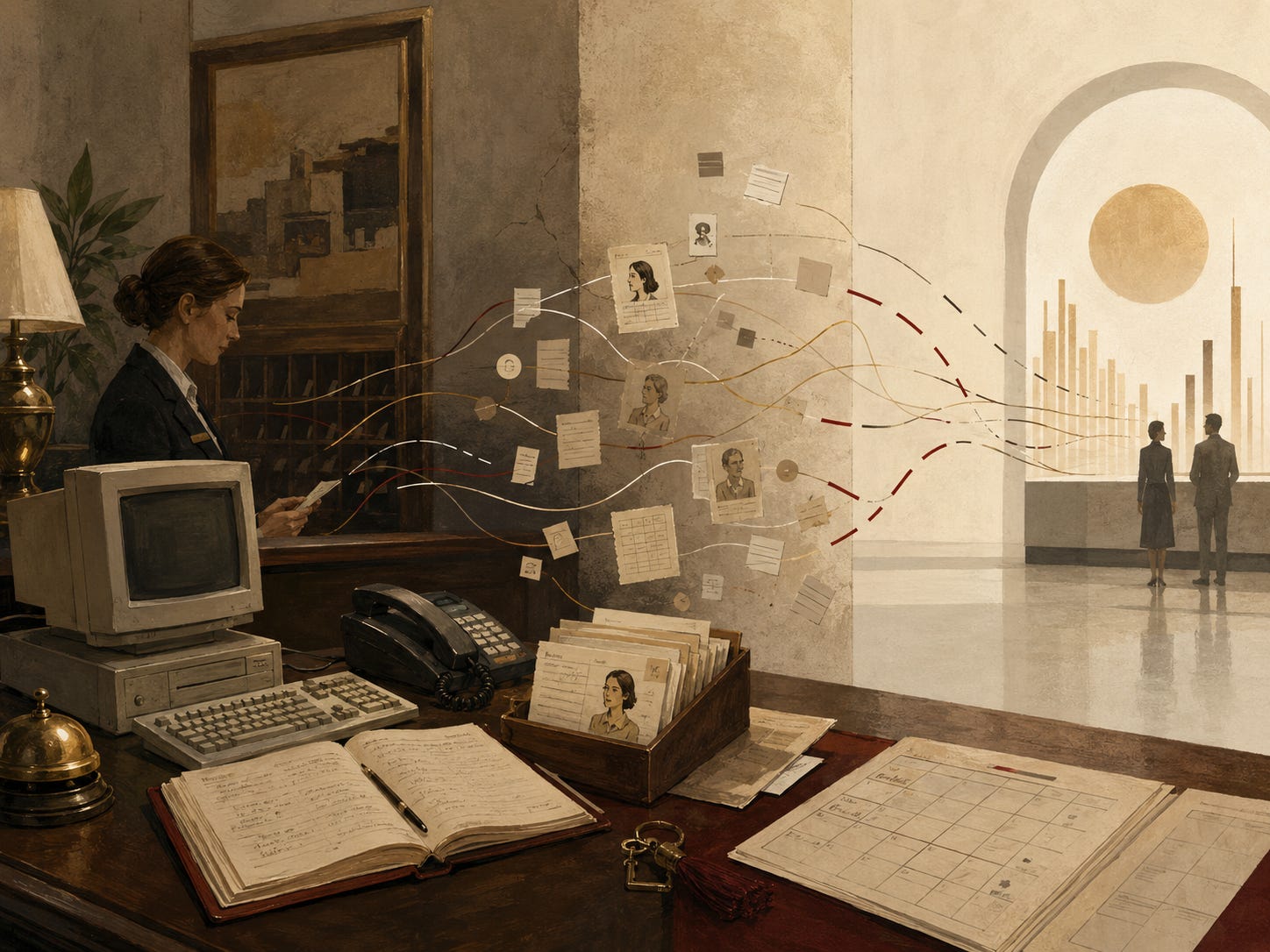
Currently we run a local, legacy, SQL-based property management system. No automations. No segmentation. Data pulling is hard and slow. Our email/SMS tooling is a basic local gateway — no segmentation, no automation. The phone system is modern. We created a simple tool that recognizes incoming numbers and displays guest history. We run Meta and Google ads with no sales tracking, as mentioned. Decent organic presence with over 35k Facebook and 15k Instagram followers. However, most traffic comes from paid sources. No content strategy yet, though we’ve started with an agency.
So over the next 9–12 months, on my own P&L, on my existing legacy PMS, with a stack costing under €100/month, three hypotheses:
Hypothesis 1: Measurement & CRM infrastructure
New PMS systems like Mews and Cloudbeds, along with add-ons like Klaviyo and Duetto, are costly. But we need to track and measure.
To-do list:
Call tracking matched to PMS sales.
Move the booking engine out of its iframe.
Feed real conversions back to the ad platforms.
Redirect spend to what actually sells.
Target: direct share of room revenue from 59% to 70%, and commissions measured in hard currency.
Hypothesis 2: Direct revenue increase
Automated email & SMS flows, per segment: welcome flow, abandoned-cart flow, thank-you flow, and so on.
And the one I’m proud of, because I don’t think many hotels do this, let alone independents: reactivation and call-back automation. We are building a system that integrates our calls, PMS and pushes the results to Google and Meta APIs. The whole system is being built on top an AI layer, with transcription and filtering capabilities.
We did this manually in June: called back 124 people, booked 17 rooms — roughly $9,500 in direct revenue. Not bad for a spreadsheet and a phone.
Hypothesis 3: Repeat guest activation
Our repeat base is the moat, so it gets its own hypothesis. Automated call, email, and SMS journeys for guests who stayed with us and went silent. The 36%-price-increase-with-5%-churn number above says this base has more to give — the question is how much, and how systematically we can harvest it without burning trust.
What’s next
This is a battle against giants. We don’t have the resources of the big groups (and my father was not a Lord), and no other income supporting this. So the whole experiment has to be cheap, fast, and repeatable. Fixing attribution on a 30-year-old hotel’s tech stack is going to be ugly.
But we have a moat most businesses don’t: guests who come back, year after year, at prices a third higher than last year.
Rocco Forte started with a café named after a palace. We started with thermal water and 128 rooms. Same bet, different scale: the family is the edge.
Most of you own or operate an independent business. This is a battle you fight every day. I promise you’ll get something for yours as well.
All the best,
Bugra